The Holy Blood of Bruges
In the Burg square of Bruges stands a double chapel. Below is the dark Romanesque chapel of Saint Basil from the twelfth century, and above is the richly painted Basilica of the Holy Blood. There is kept a small phial of rock crystal holding a piece of cloth stained with blood. It is venerated as blood of Christ, washed from his body after the Crucifixion by Joseph of Arimathea.
According to tradition, the Count of Flanders, Thierry of Alsace, brought it back from the Second Crusade in 1150. Historians note that it is first recorded in Bruges in the 1250s, and that the phial is a Byzantine perfume bottle of the eleventh or twelfth century. It may therefore have come to Flanders after the sack of Constantinople in 1204. It is enclosed in a larger glass cylinder with gold crowns, in which the faithful venerate it.
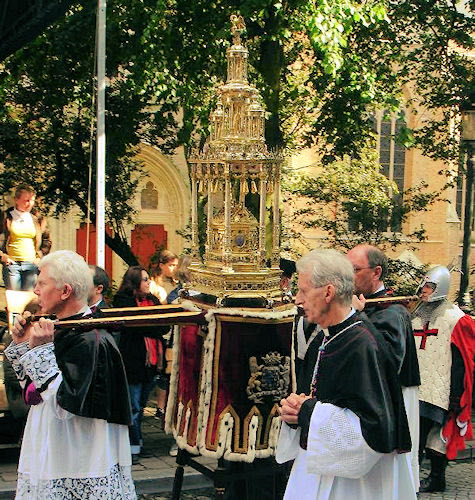
Every day, at set hours, a priest holds the relic in the chapel, and pilgrims come forward one by one to touch its case and pray. Every year on Ascension Day, since at least the fourteenth century, it is carried through the streets in the Procession of the Holy Blood, accompanied by the story of salvation acted out by the townspeople. In 2009 UNESCO recognized the procession as part of the intangible cultural heritage of humanity. The photograph shows the relic in its gold reliquary during the procession.
- Where
- Basilica of the Holy Blood, Bruges, Belgium
- When to see it
- Presented for veneration every day at set hours in the upper chapel, and carried through the city in the Procession of the Holy Blood on Ascension Day.
- Map
- Find it on OpenStreetMap