Saint Francis of Assisi
- Lived
- 1181/82–1226
- Patron of
- Italy, animals and ecology
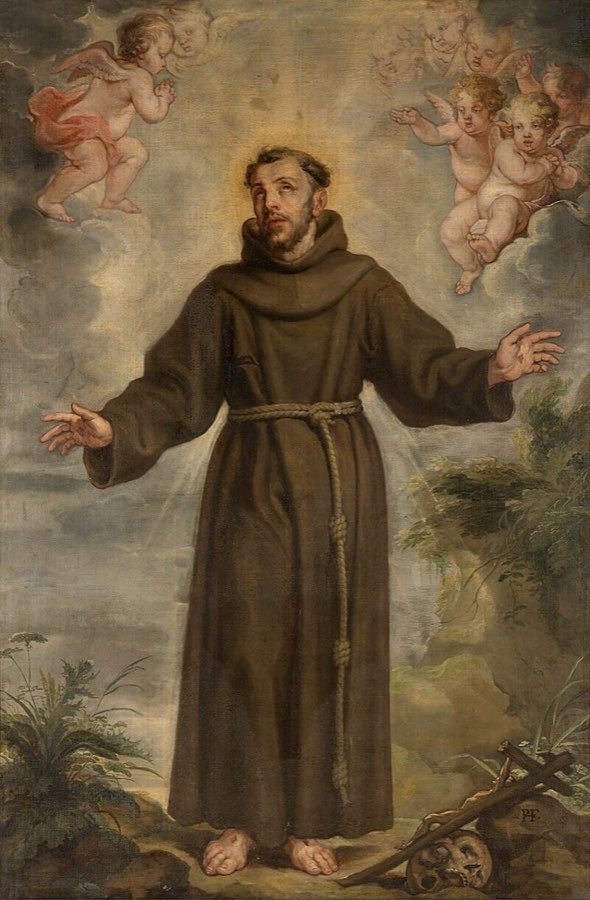
Francis was born at Assisi in Umbria in 1181 or 1182, the son of Pietro di Bernardone, a prosperous cloth merchant. He grew up cheerful, generous and fond of fine clothes and feasting, and he dreamed of glory as a knight. In a war between Assisi and Perugia he was taken prisoner and spent a year in captivity, and a long illness followed.
Slowly he turned away from his old life. He began to pray alone in the countryside and to give to beggars. One day, praying before the crucifix in the half-ruined chapel of San Damiano, he heard the words: “Francis, go and repair my house, which, as you see, is falling into ruin.” He took them literally and began to rebuild the chapel with his own hands, paying for it with his father’s cloth. When his furious father brought him before the bishop, Francis gave back everything, even the clothes he wore, and said that from now on he would call only God his Father.
He embraced the lepers he had once found repulsive, and lived in poverty, preaching penance and peace. Companions came to share his life. In 1209 or 1210 Pope Innocent III approved their simple rule, drawn from the words of the Gospel, and the Friars Minor were born. In 1212 Saint Clare left her family to follow him, and the Poor Clares began.
Francis wanted nothing of his own, not even a house. He travelled to Egypt during the Fifth Crusade in 1219 and preached before the Sultan al-Kamil. At Greccio at Christmas 1223 he set up a manger with an ox and an ass so that the people could see with their own eyes the poverty of the newborn Christ. On the mountain of La Verna in 1224 he received the stigmata, the wounds of the crucified Lord, in his own body.
Nearly blind and in great pain, he composed the Canticle of the Creatures, praising God for Brother Sun and Sister Moon, and at last for Sister Death. He died at the Portiuncula, below Assisi, on the evening of 3 October 1226, lying on the bare ground. Pope Gregory IX canonized him less than two years later.