The Holy Robe of Trier
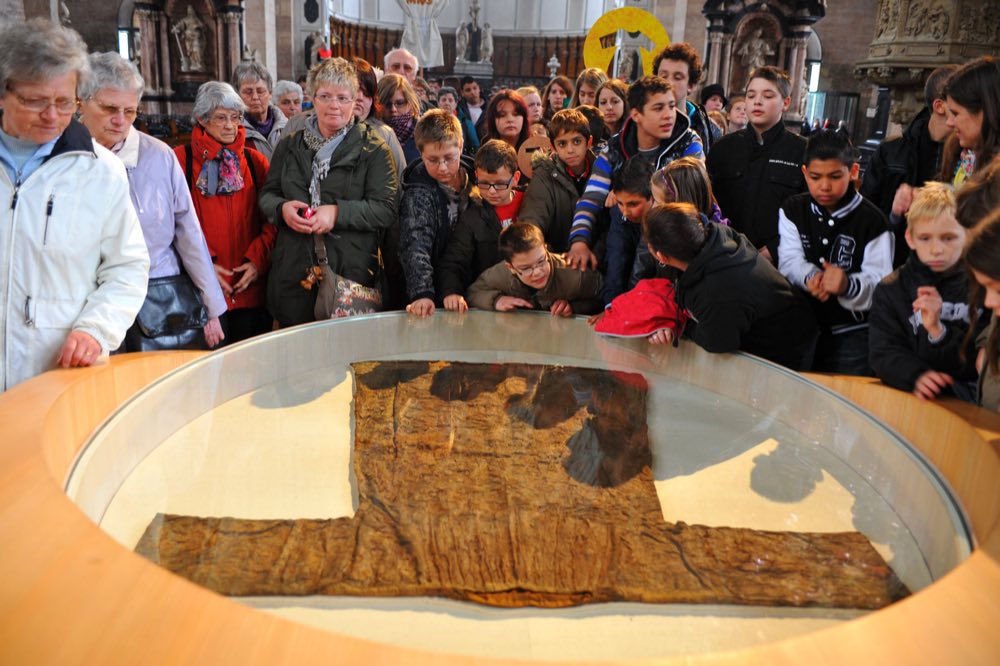
Saint John tells us that at the crucifixion the soldiers divided Jesus’s garments among them, but his tunic “was without seam, woven from the top throughout.” They said, “Let us not cut it, but let us cast lots for it, whose it shall be” (John 19:23–24).
Trier, on the Moselle, was one of the capitals of the Roman Empire, and its cathedral stands in part on the palace of the Empress Saint Helena, mother of Constantine. Tradition holds that Helena sent the robe to Trier after her pilgrimage to the Holy Land. It is first securely documented in 1196, when it was placed in the new high altar of the cathedral.
It was shown to the Emperor Maximilian I in 1512, and from then on great pilgrimages were held at long intervals. In 1844 about half a million pilgrims came to see it. The relic itself is fragile. Over the centuries the original fabric was stiffened and covered with layers of other textiles, so that little of it can be studied.
The pilgrimage of 2012 marked five hundred years since the first public showing. Its theme, “and lead together what is divided,” recalled that the seamless robe has long been seen as a sign of the unity of the Church.
- Where
- Trier Cathedral, Trier, Germany
- When to see it
- Kept in a sealed reliquary in its chapel behind the high altar, and shown only at special pilgrimages, such as those of 1959, 1996 and 2012.
- Map
- Find it on OpenStreetMap