The Titulus Crucis
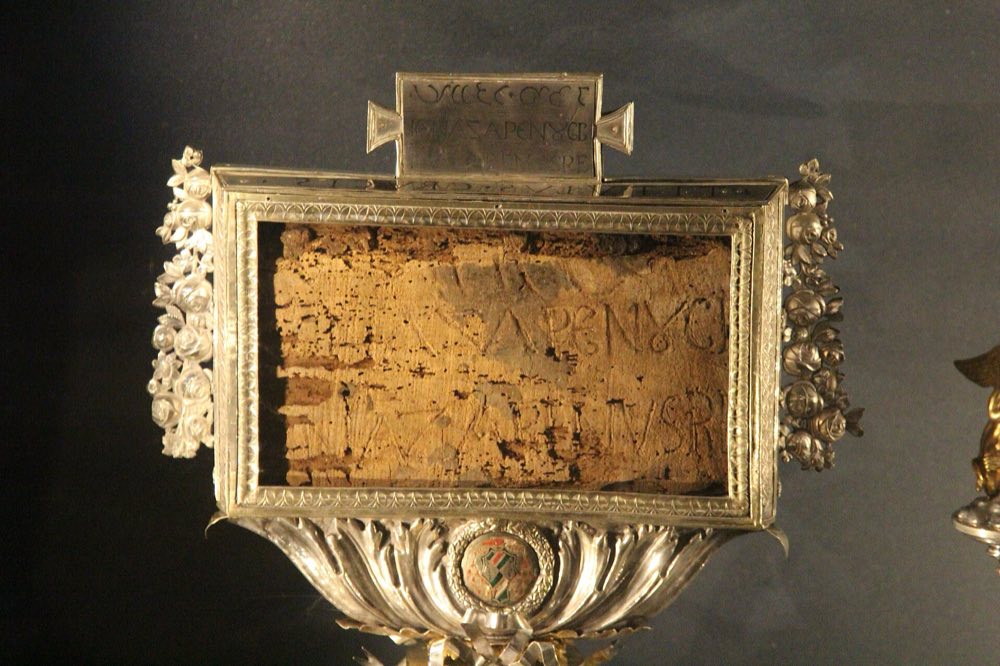
“And Pilate wrote a title also, and he put it upon the cross. And the writing was: JESUS OF NAZARETH, THE KING OF THE JEWS… and it was written in Hebrew, in Greek, and in Latin” (John 19:19–20).
The Titulus Crucis is a piece of walnut wood about 25 centimetres long. It bears the remains of an inscription in three lines. The Hebrew or Aramaic line is almost entirely lost, and the Greek and Latin lines are written, unusually, from right to left. Enough remains to read “Nazarene” in Greek and Latin.
It was rediscovered on 1 February 1492, when workmen restoring the basilica of Santa Croce found a sealed lead box hidden in the wall above an arch. Inside was the board, and the seal bore the name of Cardinal Gerardo, titular of the church in the twelfth century and later Pope Lucius II. Pope Alexander VI confirmed the discovery in 1496.
Scholars disagree about it. Some point out that the lettering and the reversed writing fit the first century. A radiocarbon test in 2002 dated the wood to between the tenth and twelfth centuries, so it may be a medieval copy of an older original. It is honoured as a sign of the kingship of Christ, proclaimed from the Cross in the languages of the whole world.
- Where
- Basilica of Santa Croce in Gerusalemme, Chapel of the Relics, Rome, Italy
- When to see it
- On view daily in the Chapel of the Relics.
- Map
- Find it on OpenStreetMap