Saint Benedict
- Lived
- c. 480 – c. 547
- Patron of
- Europe, monks and a happy death
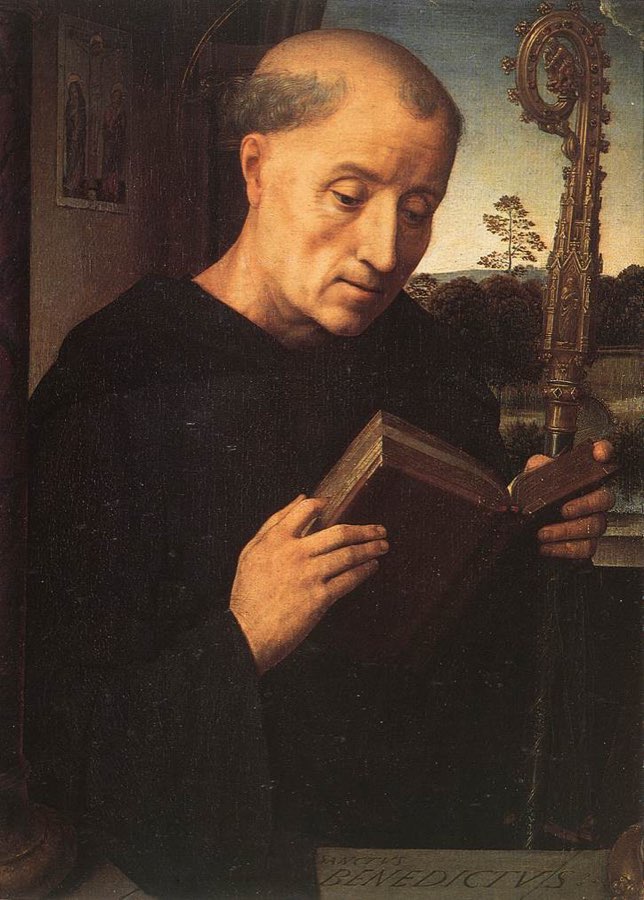
Nearly all we know of Benedict comes from the Dialogues of Pope Saint Gregory the Great, written some fifty years after his death. He was born around 480 at Nursia (Norcia) in the mountains of Umbria and sent to Rome to study. Shocked by the vice of the city, he left it “knowingly ignorant and wisely unlearned,” as Gregory puts it, to seek God alone.
For three years he lived as a hermit in a cave at Subiaco, in the hills east of Rome, fed by a monk who let bread down to him on a rope. His holiness became known, and disciples gathered around him. Some monks nearby asked him to be their abbot, but they found his rule too strict and tried to poison him. When he blessed the cup, it shattered. He went back to Subiaco and founded twelve small monasteries there.
Around 529 he moved south to Monte Cassino, a mountain above the road to Naples. He tore down a pagan temple there and built the abbey that became the mother house of his monks. There he wrote his Rule for Monks, a short and balanced guide to life in community under an abbot, “a school of the Lord’s service” in which “nothing is to be put before the Work of God.” Its spirit has been summed up in the words ora et labora, pray and work.
He died around 547, standing in the oratory, supported by his monks, after receiving Communion. Over the following centuries Benedictine monasteries kept learning, farming, hospitality and the prayer of the Church alive across Europe. In 1964 Pope Paul VI named him patron of Europe. His feast is kept on 11 July.