Saint Jerome
- Lived
- c. 347–420
- Patron of
- scholars, translators and librarians
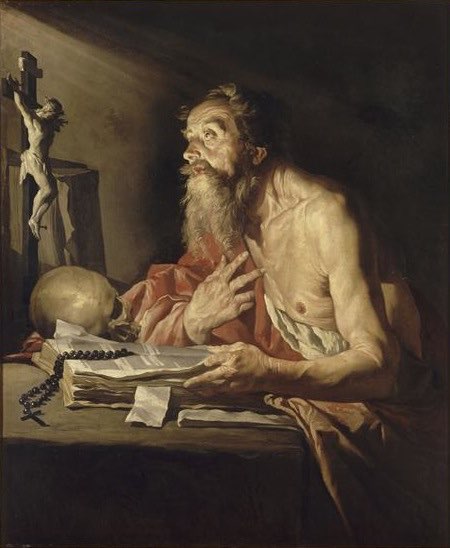
Jerome was born around the year 347 at Stridon, a small town on the border of Dalmatia and Pannonia. His parents were Christians of some means, and they sent him to Rome to study grammar and rhetoric. There he acquired a love of the Latin classics that he never quite lost, and there, as a young man, he was baptized.
After some years of travel he went east and tried the life of a hermit in the desert of Chalcis, in Syria. The solitude was hard on him, and to master his restless mind he took up the study of Hebrew with a converted Jew, a labour he later called bitter but fruitful. He was ordained a priest at Antioch and heard Saint Gregory Nazianzen preach at Constantinople.
In 382 he came back to Rome and became secretary to Pope Saint Damasus, who asked him to revise the old Latin translation of the Gospels against the Greek. When Damasus died, Jerome, who had made enemies with his sharp pen, left Rome for the Holy Land. From 386 until his death he lived at Bethlehem, near the cave of the Nativity, where his friends Saint Paula and her daughter Saint Eustochium founded monasteries for men and women.
At Bethlehem he did the work for which the Church remembers him: a new Latin translation of most of the Old Testament made directly from the Hebrew, which together with his revised Gospels became the core of the Vulgate, the Bible of the Western Church for more than a thousand years. The Douay-Rheims and the Catholic Public Domain Version on this site are both translations of that Latin text. He also wrote commentaries on nearly every book of Scripture, and a great many letters.
Jerome was not a gentle man. He was quick to quarrel and slow to forget, and he knew it. But he loved the word of God with his whole heart, and he spent his life so that others could read it. “Ignorance of the Scriptures,” he wrote, “is ignorance of Christ.” He died at Bethlehem on 30 September 420. He is a Doctor of the Church and the patron of scholars, translators and librarians.
Read: Isaiah 1, the first chapter of the book on which he wrote his longest commentary.