Saint Pio of Pietrelcina
- Lived
- 1887–1968
- Patron of
- civil defence volunteers
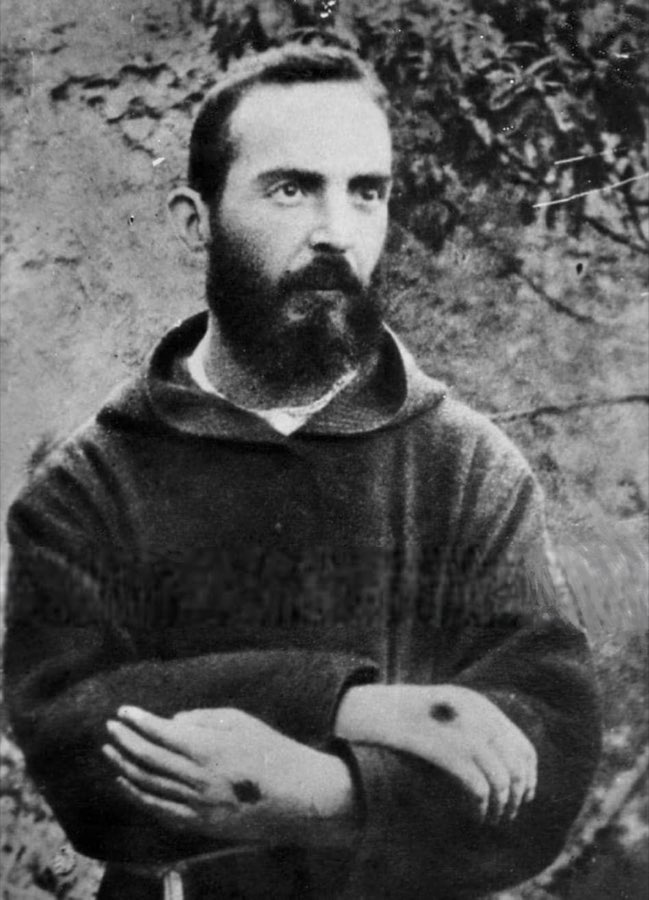
Francesco Forgione was born on 25 May 1887 in Pietrelcina, a farming village in southern Italy. His family was poor and devout, and his father twice went to America to earn money for his son’s education. At fifteen Francesco entered the Capuchin friars and took the name Pio. He was ordained in 1910, but ill health kept him with his family for several years.
In 1916 he was sent to the friary of San Giovanni Rotondo, in the Gargano mountains, and he stayed there for the rest of his life. On 20 September 1918, while praying before a crucifix, he received the stigmata: wounds in his hands, feet and side like the wounds of Christ. They bled for fifty years and caused him great pain and embarrassment. He kept them covered with gloves.
Crowds began to come. Doctors examined him, and Church authorities, suspicious, investigated him repeatedly. For a time in the 1920s and 1930s he was forbidden to say Mass in public or to hear confessions. He obeyed without complaint. His Mass, which could last hours, drew people from everywhere, and he spent long days in the confessional, where he was known to read souls. Many stories were told of healings, conversions and bilocation. He urged people to “pray, hope and don’t worry.”
He founded prayer groups that spread around the world. In 1956 he opened a large modern hospital, the Casa Sollievo della Sofferenza, the “House for the Relief of Suffering.” He died on 23 September 1968, and his wounds closed at his death. Pope John Paul II, who had gone to confession to him as a young priest, canonized him in 2002.