Saint Thomas Aquinas
- Lived
- c. 1225–1274
- Patron of
- students, schools and universities
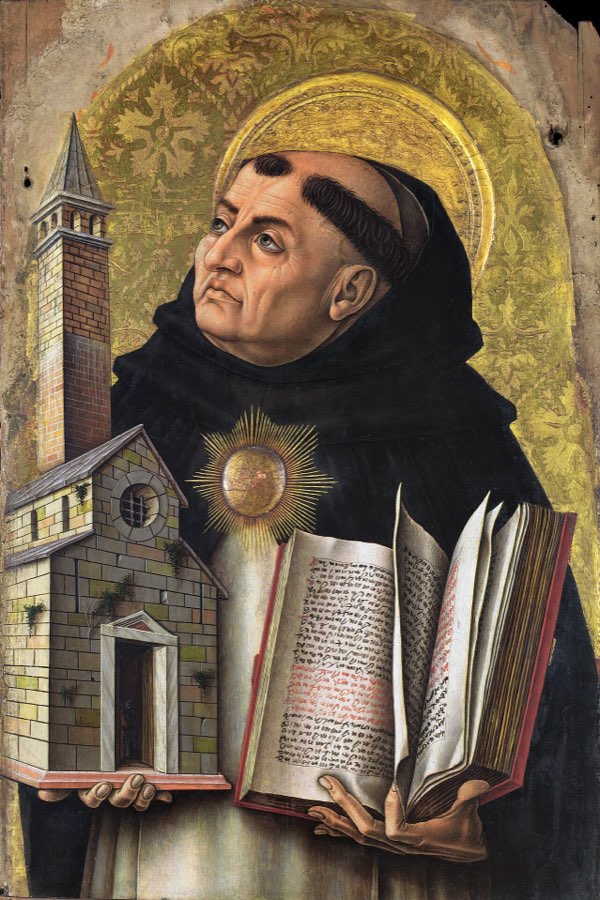
Thomas was born around 1225 in the castle of Roccasecca, between Rome and Naples, the youngest son of the Count of Aquino. At five he was sent to the great Benedictine abbey of Monte Cassino, and his family hoped he would one day be its abbot. He studied at the university of Naples, where he met the new Order of Preachers, and in 1244 he joined the Dominicans.
His family was outraged. His brothers seized him on the road and held him prisoner at home for about a year. Nothing would change his mind, and at last they let him go. He studied at Paris and Cologne under Saint Albert the Great. The other students, seeing this large, silent young man, called him “the dumb ox.” Albert answered that “the bellowing of this ox will be heard throughout the world.”
He became a master of theology at Paris and taught there and in Italy. In some twenty years he wrote an enormous body of work: commentaries on Scripture and on Aristotle, the Summa contra Gentiles and, above all, the Summa Theologiae, which sets out the whole of Christian teaching in clear order and shows that faith and reason, both gifts of God, cannot contradict each other. For the new feast of Corpus Christi he wrote hymns the Church still sings, among them the Pange lingua with its Tantum ergo.
In December 1273, after an experience at Mass, he stopped writing: “All that I have written seems to me like straw compared with what I have seen.” He died on 7 March 1274 at the abbey of Fossanova, on his way to the Council of Lyons. He was canonized in 1323 and named a Doctor of the Church in 1567.