Church of the Holy Sepulchre
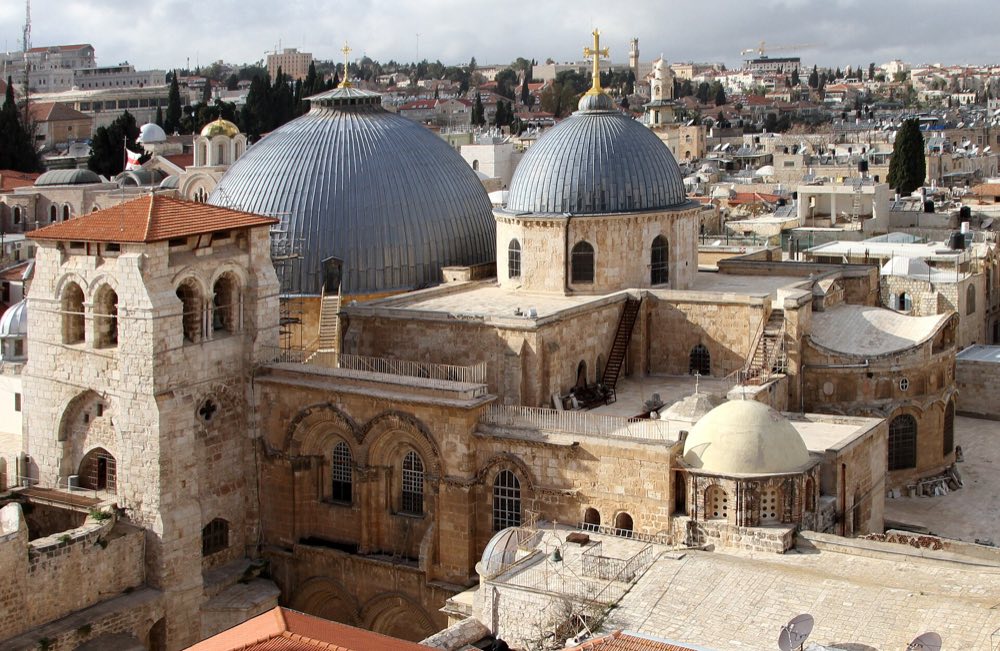
Within one crowded, many-domed church in the Old City of Jerusalem are the two holiest places in Christianity: the rock of Golgotha, where Christ was crucified, and the tomb in which he was laid and from which he rose (John 19–20).
The Emperor Constantine had a great basilica built here after his mother, Saint Helena, visited in 326. It was consecrated in 335. The church was destroyed in 1009 on the orders of the Caliph al-Hakim and partly rebuilt. The Crusaders reconsecrated the church that largely stands today in 1149. The tomb itself is enclosed in a small shrine, the Edicule, beneath the great rotunda. It was restored in 2016–2017.
The church is shared by several Christian communities under an agreement called the Status Quo: the Catholic Franciscans of the Custody of the Holy Land, the Greek Orthodox, the Armenians, the Copts, the Syriacs and the Ethiopians. Each keeps its own chapels and hours of prayer. By tradition two Muslim families hold the keys and open the great door every morning.
- Built
- Consecrated 335; present church mostly 1149
- Style
- Romanesque (Crusader), with later additions
- Where
- Jerusalem, Israel / Palestine
- Map
- Find it on OpenStreetMap