Santiago de Compostela Cathedral
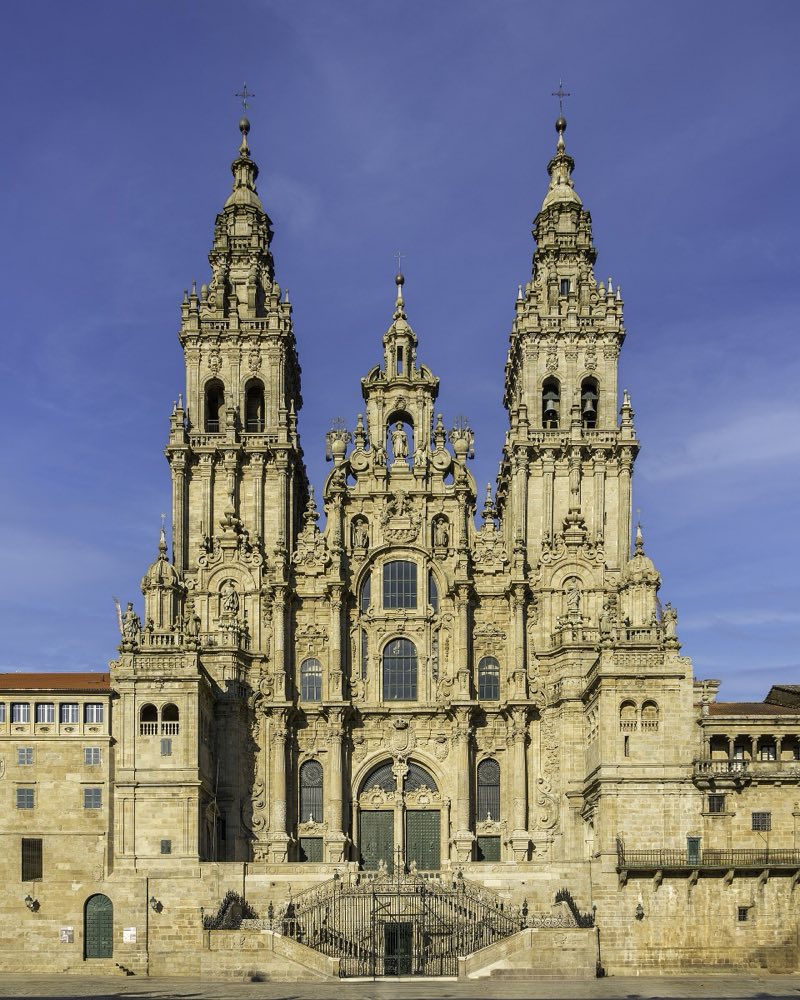
The cathedral was begun in 1075 over the tomb of the Apostle James the Greater. It became the goal of one of the three great pilgrimages of the Middle Ages. Behind its Baroque façade, the Obradoiro, added in the eighteenth century to protect the old entrance, is one of the finest Romanesque churches in Europe. The Portico of Glory, carved by Master Mateo around 1188, is crowded with smiling prophets and apostles and was restored in 2018.
At the end of the Camino, pilgrims climb behind the high altar to embrace the jewelled statue of Saint James, then go down to pray at his silver casket in the crypt. At the pilgrims’ Mass the enormous censer, the botafumeiro, is swung by eight men in great arcs across the transept, trailing clouds of incense.
Hundreds of thousands of pilgrims walk or cycle to Santiago each year. Those who have covered the last hundred kilometres on foot, or two hundred by bicycle, receive the Compostela certificate. In Holy Years, when the saint’s feast, 25 July, falls on a Sunday, the Holy Door is opened.
- Built
- 1075–1211; Obradoiro façade 1740–1750
- Style
- Romanesque and Baroque
- Where
- Santiago de Compostela, Spain
- Map
- Find it on OpenStreetMap
- Read about
- Saint James the Greater · His tomb