The Tomb of Saint James
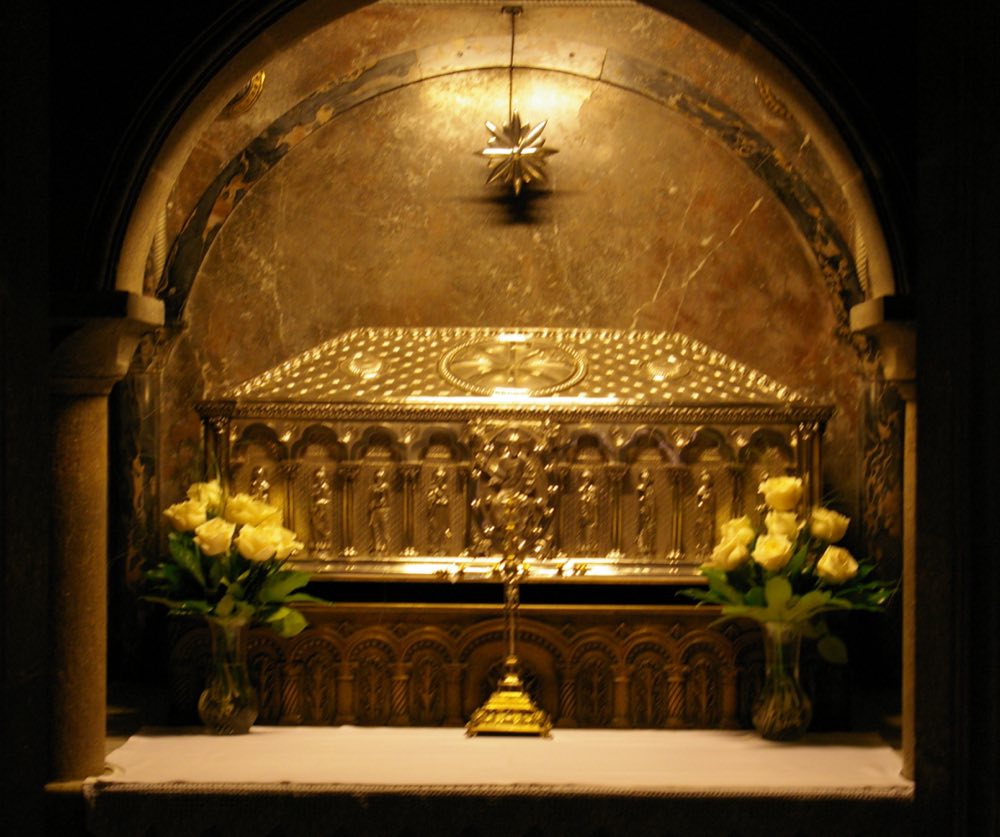
Saint James was the first of the Apostles to die for Christ, beheaded by Herod Agrippa in Jerusalem around the year 44 (Acts 12:2). An old tradition holds that he had preached in Spain, and that after his death his disciples brought his body by sea to the coast of Galicia and buried it inland.
Around the year 820, a hermit named Pelagius saw strange lights over a field. The bishop of Iria Flavia, Theodemir, found there an ancient tomb and declared it to be that of the Apostle. King Alfonso II of Asturias built a church over it, and the place came to be called Compostela, perhaps from campus stellae, the “field of the star.” Through the Middle Ages the pilgrimage to Santiago became, with Rome and Jerusalem, one of the three great pilgrimages of Christendom.
In 1589, fearing a raid by the English privateer Francis Drake, the archbishop hid the relics, and their exact location was forgotten. They were found again in excavations in 1879, and Pope Leo XIII confirmed their authenticity in 1884. They now rest in a silver casket made in 1886.
Every year hundreds of thousands of pilgrims walk the Camino de Santiago to his tomb. In the cathedral the enormous censer, the botafumeiro, swings across the transept at the pilgrims’ Mass.
- Where
- Cathedral of Santiago de Compostela (the crypt), Santiago de Compostela, Spain
- When to see it
- Open daily. Pilgrims pray at the tomb in the crypt below the high altar, and embrace the statue of the Apostle above it.
- Map
- Find it on OpenStreetMap
- Read about
- Saint James the Greater