The Holy Chalice of Valencia
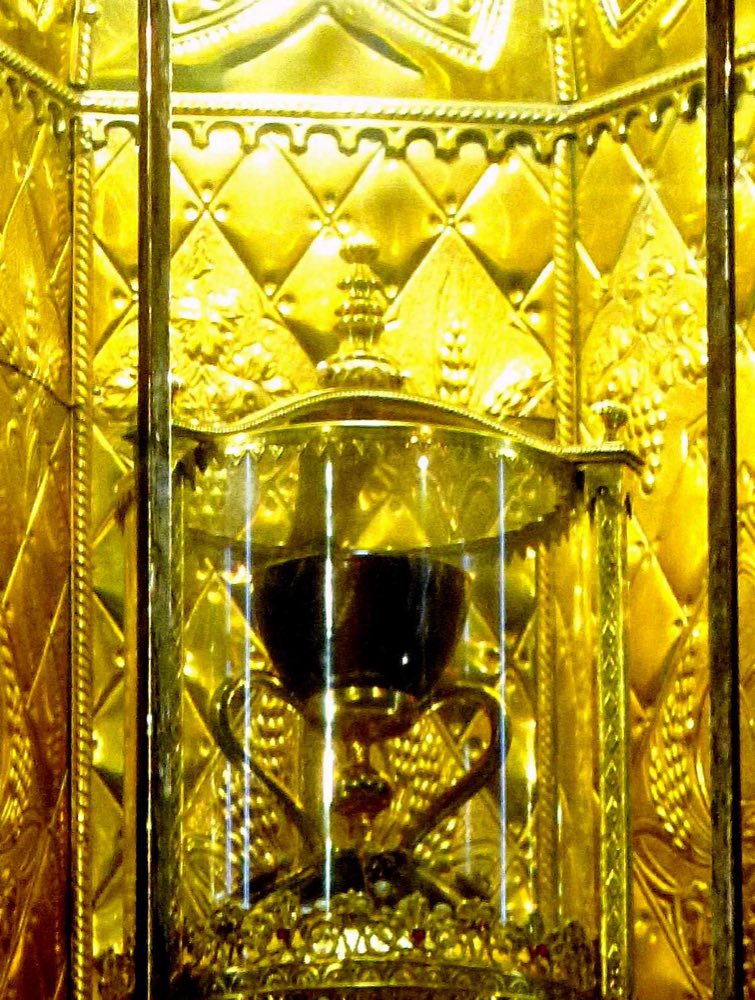
The Holy Chalice consists of a cup of dark red agate, set in a medieval mount of gold with handles, pearls and precious stones, and an upturned agate bowl for a base. Archaeologists have dated the cup itself to between the first century before Christ and the first century after, from a workshop in the Near East.
Tradition holds that it is the cup of the Last Supper, over which Christ said, “This is the chalice, the new testament in my blood” (Luke 22). According to this tradition, Saint Peter brought it to Rome, where it was used by the early popes. In the persecution of 258 the deacon Saint Lawrence sent it to his family in Huesca, in Spain, for safekeeping. It was hidden in the Pyrenees during the Moorish invasions and later kept at the monastery of San Juan de la Peña. In 1399 King Martin I of Aragon took it into the royal treasury, and in 1437 it was given to Valencia Cathedral.
Among the many cups venerated as the Holy Grail, the Valencia chalice has the strongest claim to antiquity. Two popes celebrated Mass with it on their visits to Valencia: Saint John Paul II in 1982 and Benedict XVI in 2006. Since 2015 the city has kept a Jubilee Year of the Holy Chalice every five years.
- Where
- Chapel of the Holy Chalice, Valencia Cathedral, Valencia, Spain
- When to see it
- On view daily in its chapel in the cathedral.
- Map
- Find it on OpenStreetMap