The Holy House of Loreto
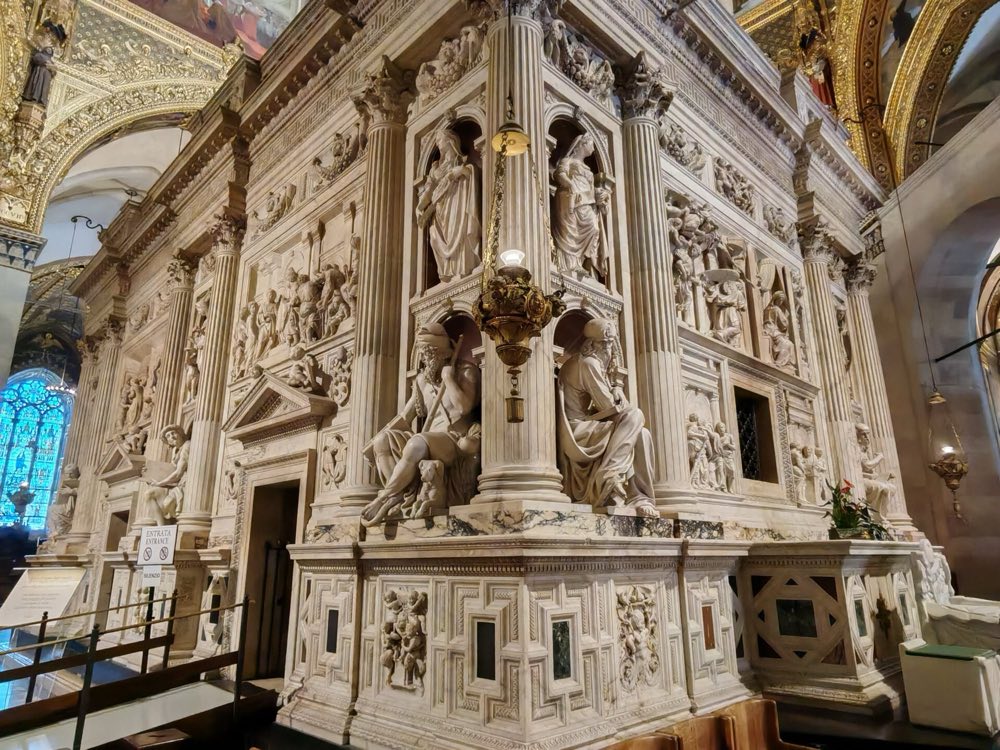
Beneath the dome of the great basilica of Loreto, on a hill near the Adriatic coast, stands a small, rough house of stone and brick, about nine metres by four. It is venerated as the house of Nazareth in which the Virgin Mary was born and lived, where the angel Gabriel announced to her that she would be the Mother of God (Luke 1), and where the Holy Family lived.
According to the tradition, when the Crusaders lost the Holy Land the house was carried by angels, first in 1291 to Tersatto, in present-day Croatia, and then in 1294 across the sea to Loreto. Historians have suggested another explanation: that its stones were brought by ship by the Angeli, a family of Byzantine rulers. Studies have found that the lower walls are built of stone worked in the manner of Nazareth, without foundations, and bear graffiti like those found in early Christian sites in the Holy Land.
In the sixteenth century Bramante designed the marble casing that now surrounds the house, carved with scenes of the life of Our Lady by Andrea Sansovino and other sculptors. Inside, above the altar, stands the dark statue of Our Lady of Loreto.
Loreto has been one of the great Marian shrines of Christendom for seven centuries. In 1920 Our Lady of Loreto was named patroness of aviators, and her feast, 10 December, was added to the General Roman Calendar in 2019.
- Where
- Basilica of the Holy House, Loreto, Italy
- When to see it
- Open daily. Pilgrims may enter the Holy House itself, inside its marble casing.
- Map
- Find it on OpenStreetMap
- Read about
- The Blessed Virgin Mary