The Eucharistic Miracle of Lanciano
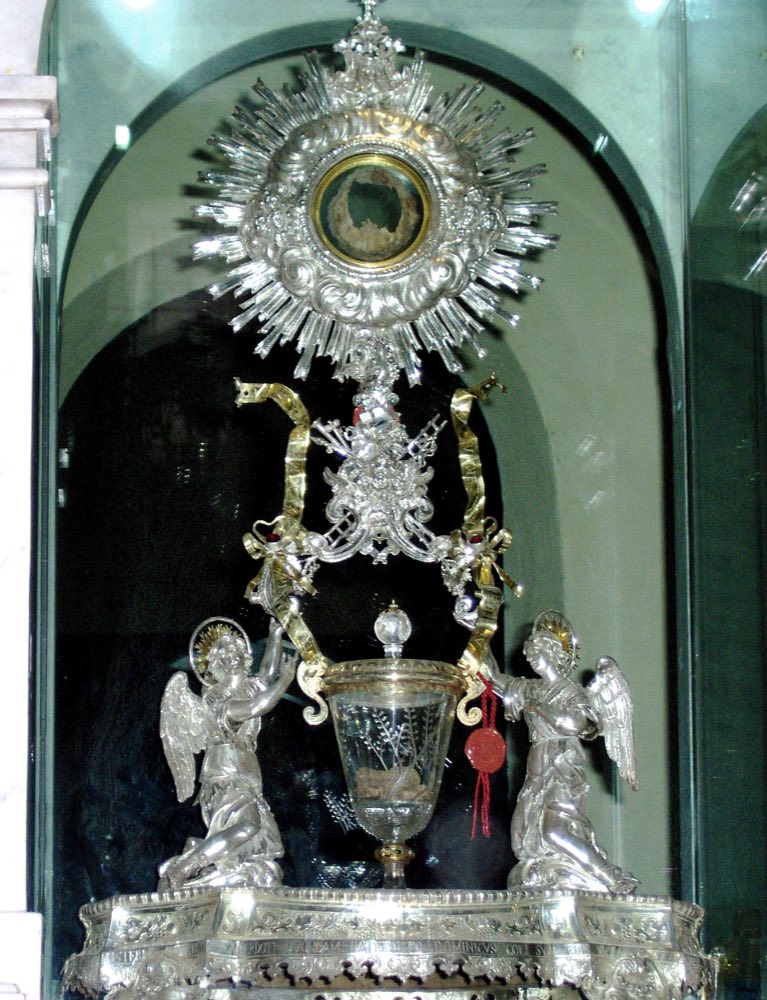
Around the year 700, in the little church of Saint Longinus at Lanciano, on the Adriatic coast of Italy, a Basilian monk was celebrating Mass. He was troubled by doubts about whether Christ was truly present in the Eucharist. As he said the words of consecration, the Host in his hands became a ring of living flesh, and the wine in the chalice became blood, which soon clotted into five small, irregular globules.
The relics have been kept ever since in the same place. The Franciscans have had charge of the church since 1252. Since 1713 the Flesh has been kept in a silver monstrance, with the Blood in a crystal chalice below.
In 1970 and 1971 the relics were examined by Professor Odoardo Linoli of the University of Siena. He reported that the Flesh was human heart muscle and that the Flesh and Blood were of the same blood group, AB. He found no trace of any preservatives, though the relics had been kept for twelve centuries without special care.
The Church encourages the faithful to venerate the miracle as a sign that strengthens faith in what happens at every Mass, whenever the priest says over the bread and wine, “This is my body… this is my blood” (Luke 22:19–20).
- Where
- Church of San Francesco (Sanctuary of the Eucharistic Miracle), Lanciano, Italy
- When to see it
- On view above the high altar: the Flesh in a silver monstrance, and the Blood in a crystal chalice beneath it.
- Map
- Find it on OpenStreetMap