The Tomb of Saint Nicholas
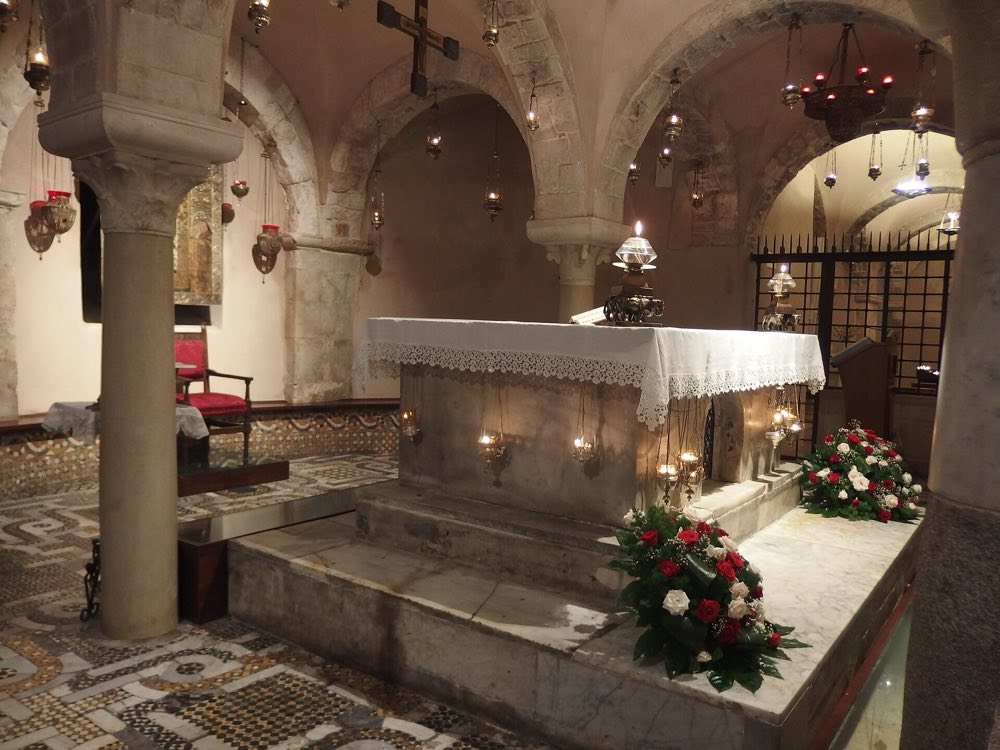
Saint Nicholas, the fourth-century bishop of Myra in Asia Minor, was buried in his cathedral city, where his tomb drew pilgrims for seven centuries. In 1087, when the region had fallen to the Seljuk Turks, sixty-two sailors from Bari, on the Adriatic coast of Italy, landed at Myra, broke open the tomb and carried off most of his bones. They arrived home on 9 May, which Bari still keeps as a great feast.
A basilica was begun at once to house the relics, and Pope Urban II placed them beneath the altar of the crypt in 1089. The Romanesque Basilica of San Nicola became one of the great pilgrim churches of the Middle Ages, and a model for many others in southern Italy.
A clear, watery liquid gathers in the tomb, called the manna of Saint Nicholas. Every year on 9 May the rector of the basilica draws it out, and it is distributed to the faithful in small bottles. Venetian sailors took the remaining small fragments of the bones to the Lido of Venice in about 1100.
Saint Nicholas is honoured equally by Catholics and Orthodox, and Bari is a place of meeting between East and West. The crypt has a chapel for the Orthodox liturgy, and pilgrims come especially from Russia, of which Nicholas is patron.
- Where
- Basilica of San Nicola (the crypt), Bari, Italy
- When to see it
- Open daily. On 9 May, the feast of the translation of his relics, the ‘manna’ is collected from the tomb.
- Map
- Find it on OpenStreetMap
- Read about
- Saint Nicholas