The Shroud of Turin
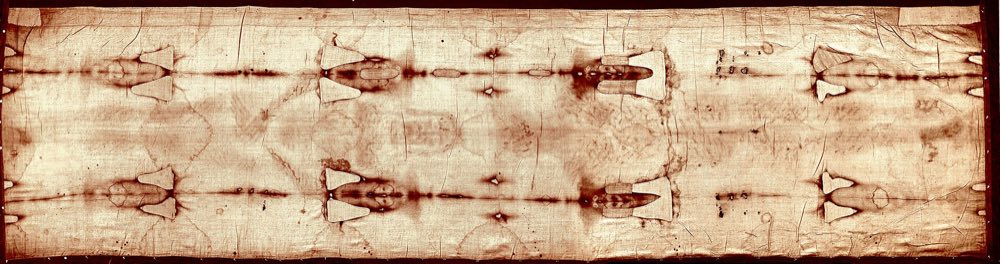
The Shroud is a linen cloth about four and a half metres long and just over a metre wide. Along its length runs the faint, straw-coloured image of the front and back of a man who has been scourged, crowned with thorns, crucified and pierced in the side, as the Gospels describe Christ’s Passion (John 19).
Its documented history begins in the 1350s at Lirey in France. In 1453 it passed to the House of Savoy, and in 1532 it was damaged by fire at Chambéry. The Poor Clare nuns patched the burn holes, which are still visible. In 1578 it was brought to Turin, and in 1983 the last King of Italy, Umberto II, left it to the Pope.
In 1898 the lawyer Secondo Pia photographed it for the first time. On his glass negative the image appeared as a detailed positive, like a photograph. In 1988 radiocarbon tests dated the linen to between 1260 and 1390, but the tests and their sampling have been much disputed, and no one has explained how the image was formed.
The Church has never pronounced on its authenticity. Saint John Paul II called it “a mirror of the Gospel.” It is an image that leads countless people to contemplate the sufferings of Christ. The photograph here is Giuseppe Enrie’s full-length photograph of 1931.
- Where
- Turin Cathedral (Cathedral of Saint John the Baptist), Turin, Italy
- When to see it
- Kept in a sealed case in the cathedral. It is shown publicly only at rare exhibitions announced by the Archbishop of Turin.
- Map
- Find it on OpenStreetMap